What Is Descriptive Statistics and Why It Matters in Data Analysis (With Real-Life Examples)
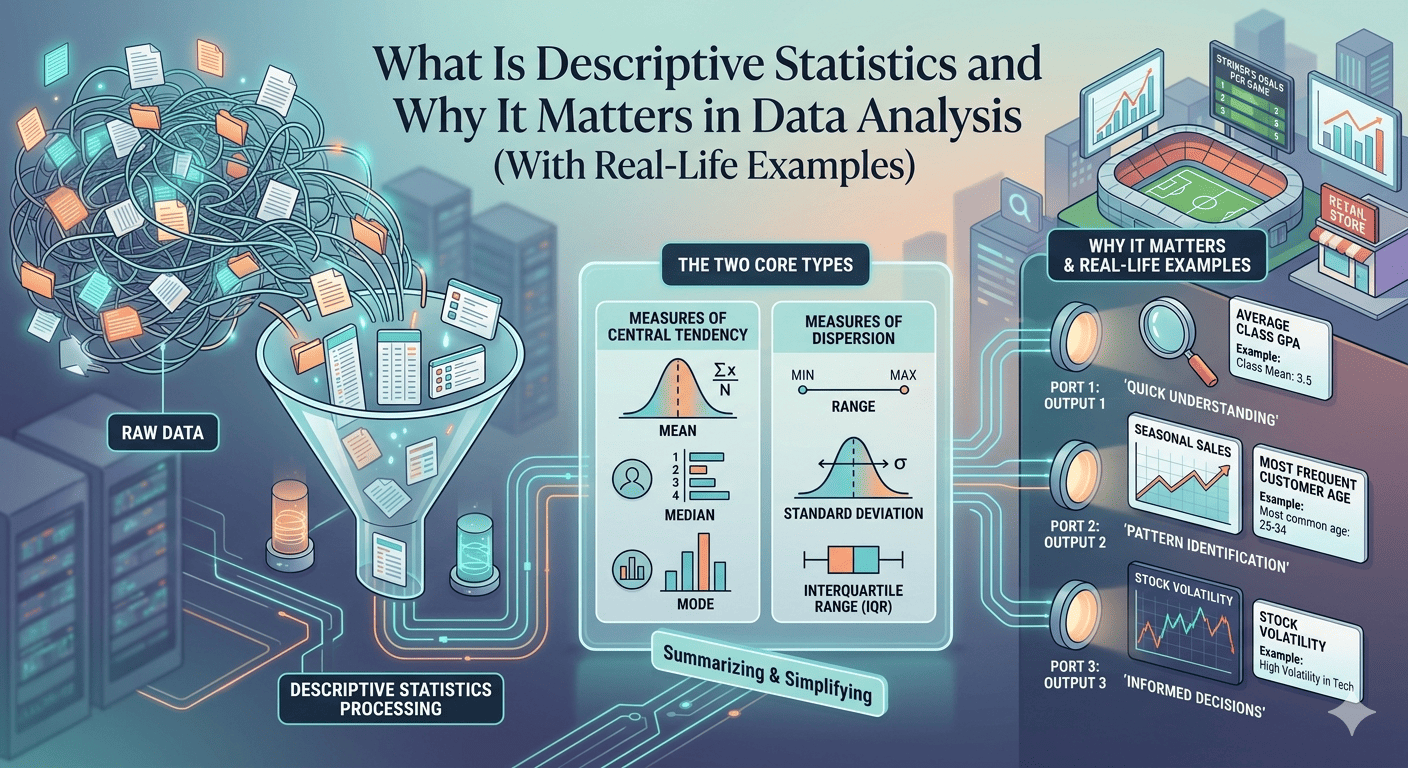
What Is Descriptive Statistics and Why It Matters in Data Analysis (With Real-Life Examples)
What You Will Learn
- What descriptive statistics means in simple terms
- Why descriptive statistics is a foundational step in data analysis
- How data appears in daily life, business, and online services
- The difference between numerical and categorical data
- How mean, median, and mode describe the center of data
- Why variability and distribution matter when interpreting numbers
- How tables and charts make data easier to understand
- Common mistakes beginners make when reading summary statistics
- How descriptive statistics supports better decisions in real-life situations
- What descriptive statistics can and cannot do
Every day, people generate data without even thinking about it. When you buy groceries, browse social media, order food online, stream a movie, or use a fitness app, information is being collected. Businesses record sales, schools track grades, hospitals monitor patient data, and websites log visits and clicks. Modern life produces a constant stream of numbers, labels, categories, and events.
The challenge is that raw data is often messy and difficult to understand at a glance. A spreadsheet with thousands of rows does not immediately tell you what is happening. You need a way to organize that information, summarize it, and turn it into something meaningful. That is where descriptive statistics comes in.
Descriptive statistics helps us answer simple but important questions. What is the average? What is most common? How much do values differ? Is the data balanced or skewed? Are there any unusual results? These summaries help people understand what their data looks like before they try to make decisions or build predictions.
What Is Descriptive Statistics
Descriptive statistics is the process of organizing, summarizing, and presenting data so it becomes easier to understand. It focuses on describing the main features of a dataset. Instead of looking at every individual data point one by one, descriptive statistics gives a clear overview using numbers, tables, and charts.
For example, suppose a store has a list of daily sales for a month. Looking at all 30 numbers separately is possible, but it is not very efficient. Descriptive statistics can summarize that month with the total sales, average daily sales, highest and lowest day, and a chart showing the trend over time.
It is important to understand what descriptive statistics does not do. It does not explain why something happened, and it does not predict what will happen next. It simply describes the data that already exists. That is why it is often considered the first step in data analysis.
Why Descriptive Statistics Matters in Data Analysis
In data analysis, descriptive statistics matters because it helps analysts quickly understand a dataset before doing anything more advanced. A large dataset can contain patterns, trends, unusual values, or data quality problems that are not obvious until it is summarized.
Descriptive statistics is useful because it helps with several tasks:
- Reducing complexity in large datasets
- Finding typical values and unusual values
- Understanding how data is distributed
- Comparing groups or time periods
- Communicating findings clearly to non-technical audiences
Before building dashboards, reports, or machine learning models, analysts usually start by exploring the data descriptively. This helps them avoid misunderstanding the dataset and creates a strong foundation for later analysis.
Real-Life Example: Understanding Sales Data
Imagine a small business owner who records daily sales for two weeks:
120, 150, 130, 170, 160, 200, 210, 180, 175, 190, 220, 210, 205, 230
Looking at the list gives some information, but it is hard to see the big picture. Descriptive statistics makes the data more useful. The owner can calculate total sales, average daily sales, the highest sales day, the lowest sales day, and how much sales change from day to day.
If the average daily sales are rising over time, that may suggest growth. If weekends are consistently higher than weekdays, that may influence staffing decisions. If one day is much lower than the rest, the owner may investigate whether there was a supply issue, a holiday, or a technical problem.
Here is a simple Python example that summarizes sales data:
sales = [120, 150, 130, 170, 160, 200, 210, 180, 175, 190, 220, 210, 205, 230]total_sales = sum(sales)
average_sales = sum(sales) / len(sales)
highest_sales = max(sales)
lowest_sales = min(sales)
range_sales = highest_sales - lowest_sales
print("Total sales:", total_sales)
print("Average sales:", round(average_sales, 2))
print("Highest day:", highest_sales)
print("Lowest day:", lowest_sales)
print("Range:", range_sales)This kind of quick summary helps the business owner understand performance without reading every value individually.
Types of Data in Real Life
Before using descriptive statistics, it helps to know what kind of data you are working with. In beginner-level analysis, two common types are numerical data and categorical data.
Numerical Data
Numerical data consists of numbers that represent counts or measurements. Examples include customer age, product price, number of website visits, delivery time, and monthly income.
Categorical Data
Categorical data consists of labels or groups. Examples include product category, payment method, city, survey response, or customer membership type.
Different descriptive methods are useful for different data types. For example, mean and variance are used with numerical data, while frequency counts and mode are often used with categorical data.
Measures of Central Tendency
Measures of central tendency describe the center of the data. In simple terms, they help answer the question: what is a typical value in this dataset?
The three most common measures are:
- Mean: the arithmetic average
- Median: the middle value when data is sorted
- Mode: the most frequently occurring value
Each measure is useful in different situations, and choosing the right one depends on the shape of the data and whether there are extreme values.
Real-Life Example: Average Salary in a Company
Suppose a small company has the following monthly salaries:
3000, 3200, 3100, 3300, 3400, 3500
To find the mean salary, add all salaries and divide by the number of employees. This gives a quick summary of the general income level in the company.
salaries = [3000, 3200, 3100, 3300, 3400, 3500]
mean_salary = sum(salaries) / len(salaries)
print("Mean salary:", mean_salary)
The mean is useful when values are fairly balanced and there are no extreme outliers. It gives a convenient single number that represents the dataset.
Real-Life Example: Median House Prices
Now consider house prices in a neighborhood:
180000, 190000, 200000, 210000, 220000, 950000
The very expensive house can pull the mean upward, making the average seem higher than what most buyers actually encounter. In this case, the median is often better because it shows the middle value and is less affected by extreme numbers.
prices = [180000, 190000, 200000, 210000, 220000, 950000]
prices.sort()
mid = len(prices) // 2
median_price = (prices[mid - 1] + prices[mid]) / 2
print("Median house price:", median_price)
In real estate reporting, median price is commonly used because it better represents a typical home price when a few luxury properties exist.
Real-Life Example: Most Popular Product
In retail, the mode is useful for finding the most frequently purchased product. Suppose a store tracks the category of each purchase:
Snacks, Drinks, Snacks, Snacks, Fruit, Drinks, Snacks
The mode is Snacks because it appears most often. This helps the store understand demand and manage inventory.
products = ["Snacks", "Drinks", "Snacks", "Snacks", "Fruit", "Drinks", "Snacks"]
mode_product = max(set(products), key=products.count)
print("Most popular product:", mode_product)
The mode is especially useful for categorical data where mean and median do not make sense.
Measures of Spread (Variability)
Knowing the center of the data is helpful, but it is not enough. Two datasets can have the same average and still be very different. That is why measures of spread are important. They show how much values differ from each other.
Common measures of spread include:
- Range: the difference between the highest and lowest values
- Variance: how far values tend to be from the mean
- Standard deviation: the square root of variance, often easier to interpret
Variability matters because it tells you whether data is tightly grouped or widely spread out.
Real-Life Example: Exam Scores Distribution
A teacher may compare two classes with the same average exam score but different levels of consistency. One class may have scores clustered close to the average, while another may have very low and very high scores.
For example:
- Class A: 70, 72, 74, 76, 78
- Class B: 50, 60, 74, 88, 98
Both classes may have a similar center, but Class B has much higher spread. That means student performance is more uneven. The teacher may decide Class B needs more targeted support.
scores = [50, 60, 74, 88, 98]
mean_score = sum(scores) / len(scores)
variance = sum((x - mean_score) ** 2 for x in scores) / len(scores)
score_range = max(scores) - min(scores)

print("Mean:", mean_score)
print("Range:", score_range)
print("Variance:", round(variance, 2))
Real-Life Example: Delivery Time Consistency
Suppose a company promises deliveries in about 30 minutes. If actual times are 29, 30, 31, 30, 29, customers will see the service as reliable. But if times are 10, 20, 30, 45, 60, the average may still be close to 33 minutes while the experience feels unpredictable.
This shows why consistency matters. Businesses often care not only about average performance but also about variation. Lower spread often means more reliable service.
Data Distribution and Shape
Data distribution describes how values are spread across a dataset. The shape of the distribution can strongly affect how you interpret statistics.
Some common shapes include:
- Symmetrical or normal-like: values are balanced around the center
- Right-skewed: most values are lower, with a few high values stretching the distribution to the right
- Left-skewed: most values are higher, with a few low values stretching the distribution to the left
When data is skewed, the mean can be pulled away from the typical value. In these cases, the median may be a better summary.
Real-Life Example: Income Distribution
Income data is often right-skewed. Many people earn low to moderate incomes, while a smaller number of very high earners pull the average upward. If a city reports a mean income that is much higher than the median income, it suggests that high earners are affecting the average.
This matters because relying only on the mean could give a misleading impression of what most people earn. In skewed data, using both mean and median gives a more complete picture.
Using Tables and Charts to Describe Data
Descriptive statistics is not limited to formulas. Tables and charts are also essential tools for summarizing data. They make patterns easier to see and help communicate findings clearly.
Common visual tools include:
- Bar charts for comparing categories
- Line charts for showing trends over time
- Histograms for showing the distribution of numerical data
- Pie charts for showing proportions, though they should be used carefully
- Frequency tables for counting occurrences
A good chart can make a summary more understandable than a page of raw numbers.
Real-Life Example: Monthly Expenses Chart
Imagine a person tracking monthly spending by category:
- Rent: 900
- Food: 300
- Transport: 120
- Entertainment: 150
- Savings: 250
A bar chart quickly shows where most money is going. Even without advanced analysis, that person can spot whether spending aligns with personal goals. If entertainment spending grows every month, they may choose to reduce it.
Here is a simple Python example using a frequency-style summary structure:
expenses = {
    "Rent": 900,
    "Food": 300,
    "Transport": 120,
    "Entertainment": 150,
    "Savings": 250
}

for category, amount in expenses.items():
    print(category, amount)
Even a simple table like this is a form of descriptive statistics because it organizes information into a readable format.
Identifying Patterns and Trends
Descriptive statistics also helps uncover patterns over time. This is especially important in business, finance, health, education, and technology. Analysts often summarize data by day, week, month, or year to look for increases, decreases, cycles, or unusual events.
When trends are visible, people can ask better follow-up questions. For example, if website traffic increases every weekend, a business may schedule promotions for those days. If customer complaints spike after a product update, a company may investigate the release.
Real-Life Example: Website Traffic Analysis
Suppose a website tracks daily visitors over one week:
500, 520, 510, 600, 750, 800, 780
A quick summary shows that traffic rises toward the end of the week. This might suggest that user activity is stronger on weekends or after a marketing campaign.
visitors = [500, 520, 510, 600, 750, 800, 780]
avg_visitors = sum(visitors) / len(visitors)
max_visitors = max(visitors)
min_visitors = min(visitors)

print("Average visitors:", round(avg_visitors, 2))
print("Peak visitors:", max_visitors)
print("Lowest visitors:", min_visitors)
By pairing these values with a line chart, an analyst can clearly show traffic growth and peak usage times.
Common Mistakes When Interpreting Descriptive Statistics
Beginners often make a few common mistakes when reading summary statistics. Understanding these mistakes helps prevent poor decisions.
- Relying only on the mean: if data has outliers, the mean may not represent a typical value well
- Ignoring spread: two groups with the same average can behave very differently if one has much higher variability
- Ignoring outliers: unusual values can reveal important issues, such as fraud, errors, or rare events
- Using the wrong chart: poor visual choices can hide patterns or create confusion
- Assuming description means explanation: descriptive statistics shows what the data looks like, not why it looks that way
For example, if a restaurant sees average daily customers of 100, that does not mean every day is close to 100. Some days may have 40 customers and others 160. Without looking at spread or trends, management might misunderstand actual demand.
How Descriptive Statistics Supports Decision Making
Descriptive statistics supports decision making by giving people a clearer picture of reality. When data is summarized well, decisions become more informed and less based on guesswork.
Businesses use descriptive statistics to track sales, customer behavior, inventory levels, and campaign performance. Individuals use it to manage budgets, monitor health, or evaluate personal progress. Schools, hospitals, governments, and nonprofit organizations all depend on descriptive summaries to understand what is happening.
It is not the final step in analysis, but it is often the first useful step. Good decisions start with a good understanding of the current data.
Real-Life Example: Choosing the Best Marketing Strategy
Imagine a company runs three marketing campaigns and tracks the number of leads generated:
- Campaign A: 120 leads
- Campaign B: 180 leads
- Campaign C: 140 leads
At a basic level, descriptive statistics makes the comparison easy. Campaign B performed best by total leads. If the company also tracks cost, conversion rate, and daily variation, it can build a more complete descriptive summary before deciding where to invest next.
campaigns = {
    "Campaign A": 120,
    "Campaign B": 180,
    "Campaign C": 140
}

best_campaign = max(campaigns, key=campaigns.get)
print("Best campaign:", best_campaign)
print("Leads:", campaigns[best_campaign])
This does not prove why Campaign B worked best, but it gives a clear description of the outcome and supports the next decision.
Limitations of Descriptive Statistics
Descriptive statistics is powerful, but it has limits. It can summarize data, but it cannot predict the future or explain cause and effect.
For example, if sales increased last month, descriptive statistics can show that increase clearly. But it cannot confirm whether the cause was better advertising, seasonal demand, lower prices, or something else. To answer those questions, analysts may need inferential statistics, experiments, or predictive models.
Descriptive statistics also depends on data quality. If the original data is incomplete, biased, or incorrect, the summary may also be misleading. A clean summary of poor data is still poor analysis.
Summary
Descriptive statistics is the practice of summarizing and organizing data so it becomes easier to understand. It helps analysts and beginners quickly see what is typical, what is unusual, how values are spread out, and whether patterns exist.
Key tools include measures of central tendency such as mean, median, and mode; measures of spread such as range and variance; and visual summaries such as tables and charts. These tools are useful in many real-life situations, including sales analysis, salaries, house prices, exam scores, delivery times, expenses, website traffic, and marketing performance.
Most importantly, descriptive statistics turns raw data into understandable information. That makes it one of the most important first steps in data analysis.
Conclusion
If you are new to data analysis, descriptive statistics is one of the best places to start. It gives you practical tools to summarize data, communicate results, and understand what is happening before moving into deeper analysis.
Whether you are analyzing sales numbers, student scores, house prices, or website visitors, descriptive statistics helps simplify complexity. It does not tell you everything, but it gives you a clear picture of the data you already have. In real-world analysis, that clear picture is often the foundation for better questions, better reports, and better decisions.