Understanding SOLID Principles in Laravel with Practical Examples
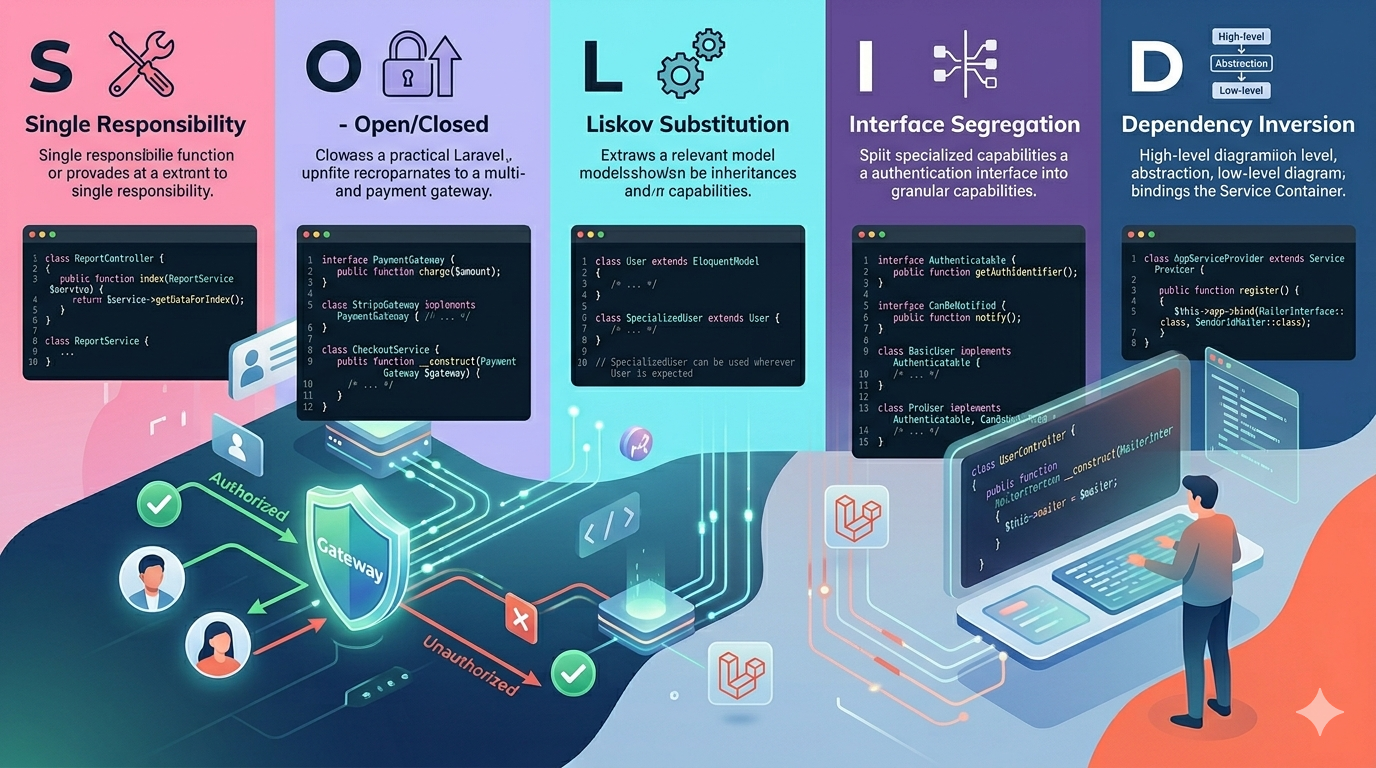
Understanding SOLID Principles in Laravel with Practical Examples
What You Will Learn
- Why clean code and software design matter in Laravel applications
- What SOLID principles are and how each principle improves code quality
- How to identify common SOLID violations in Laravel code
- How to refactor Laravel classes using SRP, OCP, LSP, ISP, and DIP
- How Laravel features such as service containers and interfaces support SOLID design
- How to apply SOLID principles in real-world projects without over-engineering
Introduction to Clean Code and Software Design
Modern Laravel applications often grow quickly. A project may start with a few routes, controllers, and models, but over time it can become a large system with business rules, integrations, jobs, notifications, APIs, and admin tools. If the codebase is poorly designed, every new feature becomes slower to build and riskier to release.
Clean code is not only about making code look nice. It is about writing software that is easy to read, test, extend, and maintain. Good software design helps teams reduce duplication, isolate changes, and avoid fragile code that breaks when requirements evolve.
SOLID principles are a practical set of object-oriented design guidelines that help developers structure code in a better way. In Laravel, these principles fit naturally with common patterns such as services, repositories, actions, interfaces, dependency injection, and the service container.
What Are SOLID Principles
SOLID is an acronym for five design principles that help developers build flexible and maintainable object-oriented software:
- Single Responsibility Principle
- Open/Closed Principle
- Liskov Substitution Principle
- Interface Segregation Principle
- Dependency Inversion Principle
These principles do not force a single architecture. Instead, they guide you toward code that is easier to understand and safer to change.
Why SOLID Principles Matter
When SOLID principles are applied well, code becomes simpler to work with over time. This is especially important in Laravel projects where business logic can easily leak into controllers, models, listeners, console commands, and service classes.
- They reduce code complexity by keeping responsibilities clear
- They improve readability by making classes easier to understand
- They make systems easier to extend without rewriting old code
- They reduce bugs when requirements change
- They improve testability by making dependencies explicit and replaceable
- They help teams collaborate more effectively in growing applications
Overview of the Five SOLID Principles
Before looking at code, here is a quick overview of each principle.
- Single Responsibility Principle: a class should have one responsibility and one reason to change.
- Open/Closed Principle: software entities should be open for extension but closed for modification.
- Liskov Substitution Principle: derived classes should be replaceable for their base classes without breaking behavior.
- Interface Segregation Principle: clients should not be forced to depend on methods they do not use.
- Dependency Inversion Principle: high-level modules should depend on abstractions, not concrete implementations.
Single Responsibility Principle (SRP)
The Single Responsibility Principle says that a class should have only one reason to change. In simple terms, a class should focus on one job.
A common Laravel mistake is putting too much into one class. For example, a service may fetch data, validate it, calculate totals, format output, send emails, and write logs. This makes the class hard to test and hard to modify. A small change in formatting should not require touching data processing logic.
SRP Violation Example in Laravel
In the following example, one class loads order data, calculates totals, and formats the response as JSON. These are multiple responsibilities in one place.
<?php

namespace App\Services;

use App\Models\Order;

class OrderReportService
{
    public function generate(int $orderId): string
    {
        $order = Order::with('items')->findOrFail($orderId);

        $total = 0;
        foreach ($order->items as $item) {
            $total += $item->price * $item->quantity;
        }

        return json_encode([
            'order_id' => $order->id,
            'customer' => $order->customer_name,
            'total' => number_format($total, 2),
        ]);
    }
}
This class has at least three responsibilities:
- Loading order data
- Calculating the total
- Formatting the output
If you want to change the output format from JSON to an array, or change how totals are calculated, you must modify the same class. That is a sign of poor separation of concerns.
SRP Correct Implementation in Laravel
We can refactor this by separating the calculation logic from the formatting logic.
<?php

namespace App\Services;

use App\Models\Order;

class OrderTotalCalculator
{
    public function calculate(Order $order): float
    {
        return $order->items->sum(function ($item) {
            return $item->price * $item->quantity;
        });
    }
}
<?php
namespace App\Services;
use App\Models\Order;
class OrderReportFormatter
{
public function format(Order $order, float $total): array
{
return [
'order_id' => $order->id,
'customer' => $order->customer_name,
'total' => number_format($total, 2),
];
}
}<?php
namespace App\Services;
use App\Models\Order;
class OrderReportService
{
public function __construct(
protected OrderTotalCalculator $calculator,
protected OrderReportFormatter $formatter
) {}
public function generate(int $orderId): array
{
$order = Order::with('items')->findOrFail($orderId);
$total = $this->calculator->calculate($order);
return $this->formatter->format($order, $total);
}
}This version is better because each class does one thing. It is easier to test calculation logic separately from formatting logic, and future changes are more isolated.
Open/Closed Principle (OCP)
The Open/Closed Principle says that classes should be open for extension but closed for modification. That means you should be able to add new behavior without editing stable existing code again and again.
This reduces the risk of breaking old behavior when adding new features. In Laravel applications, OCP often appears when handling payment methods, export formats, notification channels, or discount strategies.
OCP Violation Example in Laravel
Here is a service that sends notifications using conditional logic. Every time a new channel is added, the class must be modified.
<?php

namespace App\Services;

class NotificationService
{
    public function send(string $channel, string $message): void
    {
        if ($channel === 'email') {
            // send email
        } elseif ($channel === 'sms') {
            // send sms
        } elseif ($channel === 'slack') {
            // send slack message
        }
    }
}
This design does not scale well. As channels grow, the class becomes harder to maintain and easier to break.
OCP Correct Implementation in Laravel
We can improve this by introducing an interface and separate channel classes.
<?php

namespace App\Contracts;

interface NotificationChannelInterface
{
    public function send(string $message): void;
}
<?php
namespace App\Services\Notifications;
use App\Contracts\NotificationChannelInterface;
class EmailChannel implements NotificationChannelInterface
{
public function send(string $message): void
{
// send email
}
}<?php
namespace App\Services\Notifications;
use App\Contracts\NotificationChannelInterface;
class SmsChannel implements NotificationChannelInterface
{
public function send(string $message): void
{
// send sms
}
}<?php
namespace App\Services;
use App\Contracts\NotificationChannelInterface;
class NotificationService
{
public function __construct(protected NotificationChannelInterface $channel) {}
public function send(string $message): void
{
$this->channel->send($message);
}
}Now you can add a new SlackChannel without changing NotificationService. The class is closed for modification but open for extension through new implementations.
Liskov Substitution Principle (LSP)
The Liskov Substitution Principle states that a subclass should be able to replace its parent class without causing incorrect behavior. In practice, inheritance should preserve expectations.
If a class extends another class but changes behavior in a surprising way, it violates LSP. This often happens when developers force inheritance where composition would be better.
LSP Violation Example in Laravel
Suppose we have a base file export class that always returns a downloadable file path. Then a subclass throws an exception because it cannot actually export.
<?php

namespace App\Services\Exports;

class Exporter
{
    public function export(array $data): string
    {
        return '/exports/file.csv';
    }
}
<?php
namespace App\Services\Exports;
class NullExporter extends Exporter
{
public function export(array $data): string
{
throw new \RuntimeException('Export is disabled.');
}
}If code expects every Exporter to return a file path, replacing it with NullExporter breaks that assumption. The subclass is not substitutable.
LSP Correct Implementation in Laravel
A better design is to define a proper contract and create implementations that honor it consistently. If an exporter cannot export, it probably should not implement the same interface.
<?php

namespace App\Contracts;

interface ExporterInterface
{
    public function export(array $data): string;
}
<?php
namespace App\Services\Exports;
use App\Contracts\ExporterInterface;
class CsvExporter implements ExporterInterface
{
public function export(array $data): string
{
return '/exports/file.csv';
}
}<?php
namespace App\Services;
use App\Contracts\ExporterInterface;
class ReportService
{
public function __construct(protected ExporterInterface $exporter) {}
public function generate(array $data): string
{
return $this->exporter->export($data);
}
}If exporting is optional, handle that in configuration or in a separate workflow instead of creating a fake child class with incompatible behavior.
Interface Segregation Principle (ISP)
The Interface Segregation Principle says that clients should not be forced to depend on methods they do not use. Large interfaces often create unnecessary coupling.
In Laravel projects, this can happen when one interface tries to describe many unrelated capabilities such as creating, updating, deleting, exporting, emailing, and logging.
ISP Violation Example in Laravel
Here a large interface forces all implementations to define methods they may not need.
<?php

namespace App\Contracts;

interface UserManagerInterface
{
    public function create(array $data): mixed;
    public function update(int $id, array $data): mixed;
    public function delete(int $id): bool;
    public function export(): string;
    public function sendWelcomeEmail(int $id): void;
}
<?php
namespace App\Services;
use App\Contracts\UserManagerInterface;
class UserExporter implements UserManagerInterface
{
public function create(array $data): mixed
{
throw new \BadMethodCallException();
}
public function update(int $id, array $data): mixed
{
throw new \BadMethodCallException();
}
public function delete(int $id): bool
{
throw new \BadMethodCallException();
}
public function export(): string
{
return 'users.csv';
}
public function sendWelcomeEmail(int $id): void
{
throw new \BadMethodCallException();
}
}This is a clear sign that the interface is too broad.
ISP Correct Implementation in Laravel
Split the large interface into smaller focused contracts.
<?php

namespace App\Contracts;

interface CreatesUsersInterface
{
    public function create(array $data): mixed;
}

interface UpdatesUsersInterface
{
    public function update(int $id, array $data): mixed;
}

interface DeletesUsersInterface
{
    public function delete(int $id): bool;
}

interface ExportsUsersInterface
{
    public function export(): string;
}

interface SendsWelcomeEmailInterface
{
    public function sendWelcomeEmail(int $id): void;
}
<?php
namespace App\Services;
use App\Contracts\ExportsUsersInterface;
class UserExporter implements ExportsUsersInterface
{
public function export(): string
{
return 'users.csv';
}
}Now classes only implement what they actually need. This keeps contracts cleaner and reduces accidental dependencies.
Dependency Inversion Principle (DIP)
The Dependency Inversion Principle says high-level modules should not depend on low-level modules. Both should depend on abstractions. In Laravel, this usually means depending on interfaces instead of concrete classes.
This principle works very well with Laravel's service container because the container can resolve interface bindings to concrete implementations automatically.
DIP Violation Example in Laravel
In this example, the service directly depends on a concrete gateway class.
<?php

namespace App\Services;

class StripePaymentGateway
{
    public function charge(float $amount): bool
    {
        return true;
    }
}
<?php
namespace App\Services;
class CheckoutService
{
protected StripePaymentGateway $gateway;
public function __construct()
{
$this->gateway = new StripePaymentGateway();
}
public function process(float $amount): bool
{
return $this->gateway->charge($amount);
}
}This is tightly coupled. If you want to switch to PayPal or use a fake gateway in tests, you must change the class itself.
DIP Correct Implementation in Laravel
Refactor the service to depend on an abstraction.
<?php

namespace App\Contracts;

interface PaymentGatewayInterface
{
    public function charge(float $amount): bool;
}
<?php
namespace App\Services;
use App\Contracts\PaymentGatewayInterface;
class StripePaymentGateway implements PaymentGatewayInterface
{
public function charge(float $amount): bool
{
return true;
}
}<?php
namespace App\Services;
use App\Contracts\PaymentGatewayInterface;
class CheckoutService
{
public function __construct(protected PaymentGatewayInterface $gateway) {}
public function process(float $amount): bool
{
return $this->gateway->charge($amount);
}
}<?php
namespace App\Providers;
use Illuminate\Support\ServiceProvider;
use App\Contracts\PaymentGatewayInterface;
use App\Services\StripePaymentGateway;
class AppServiceProvider extends ServiceProvider
{
public function register(): void
{
$this->app->bind(PaymentGatewayInterface::class, StripePaymentGateway::class);
}
}This design is more flexible and more testable. In tests, you can bind a fake implementation. In production, you can swap providers with minimal changes.
Real World Example Combining SOLID Principles
Let us look at a simple payment processing flow where multiple SOLID principles work together.
Imagine an e-commerce Laravel app that needs to:
- Calculate order totals
- Charge a payment gateway
- Send a confirmation notification
- Allow different payment providers and notification channels
A good design might look like this:
<?php

namespace App\Services;

use App\Contracts\PaymentGatewayInterface;
use App\Contracts\NotificationChannelInterface;
use App\Models\Order;

class OrderTotalService
{
    public function calculate(Order $order): float
    {
        return $order->items->sum(fn ($item) => $item->price * $item->quantity);
    }
}

class PaymentProcessor
{
    public function __construct(
        protected OrderTotalService $totalService,
        protected PaymentGatewayInterface $gateway,
        protected NotificationChannelInterface $notifier
    ) {}

    public function handle(Order $order): void
    {
        $total = $this->totalService->calculate($order);
        $this->gateway->charge($total);
        $this->notifier->send('Payment completed for order #' . $order->id);
    }
}
This example applies several principles:
- SRP: total calculation, payment, and notification are separated
- OCP: new payment gateways or notification channels can be added without changing the processor
- ISP: contracts are focused and small
- DIP: the processor depends on interfaces, not concrete services
This kind of structure scales better than putting all logic in a controller or a single service class.
Common Mistakes When Applying SOLID
SOLID is helpful, but it should be applied with judgment. Here are common mistakes developers make:
- Over-engineering: creating too many classes and interfaces for a simple feature
- Abstracting too early: adding interfaces before there is a real need for multiple implementations
- Using inheritance too much: forcing class hierarchies where composition is simpler
- Ignoring Laravel conventions: using patterns that fight the framework instead of working with it
- Applying principles mechanically: following rules without understanding the underlying problem
The goal is not maximum abstraction. The goal is maintainable code.
Best Practices for Using SOLID in Laravel Projects
- Keep controllers thin and move business logic into dedicated services or actions
- Use interfaces where you need flexibility, swapping, or easier testing
- Prefer composition over inheritance when behavior varies
- Break large classes into smaller focused classes
- Use Laravel's service container for dependency injection and bindings
- Write tests to confirm your abstractions behave consistently
- Refactor gradually instead of trying to redesign everything at once
- Start simple, then introduce abstractions when the codebase shows a real need
In real projects, SOLID often works best as a refactoring guide. When code becomes difficult to change, look for which principle is being violated.
Summary
SOLID principles help Laravel developers write code that is easier to maintain, test, and extend. SRP keeps responsibilities focused. OCP allows new behavior without changing existing code. LSP ensures inheritance stays safe and predictable. ISP promotes smaller and cleaner contracts. DIP reduces coupling by depending on abstractions.
Used together, these principles make Laravel applications more stable as they grow. They also improve collaboration because code becomes easier for other developers to understand and modify.
Conclusion
Understanding SOLID principles is an important step toward writing better Laravel code. You do not need to apply every principle everywhere, but learning to recognize design problems and refactor toward clearer structure will make a big difference in your projects.
Start with small improvements. Move logic out of bloated controllers, separate responsibilities, depend on interfaces when useful, and design classes around clear behavior. With regular practice, SOLID becomes less of a theory and more of a natural way to build maintainable Laravel applications.